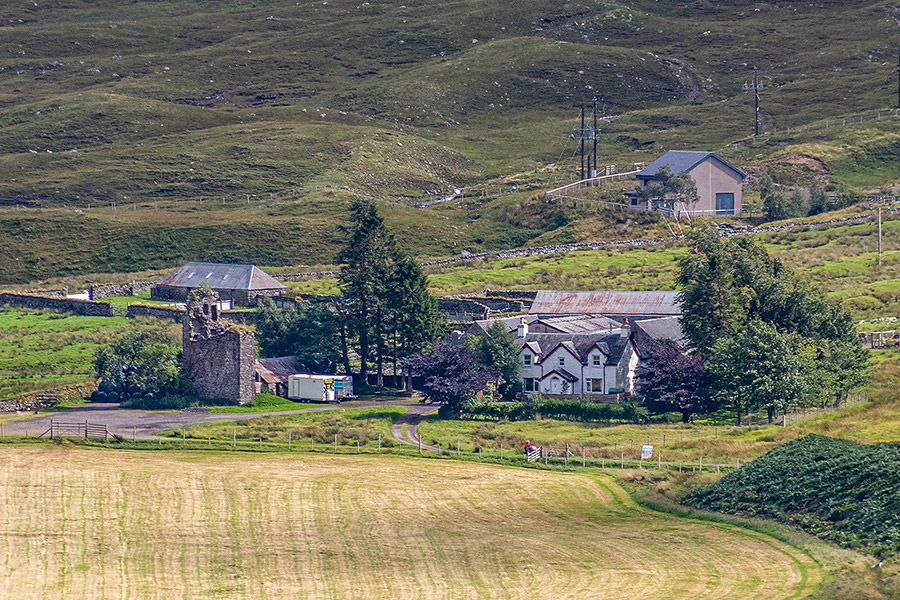
Achallader Castle is an early 17th century tower which may have replaced or incorporated part of an earlier castle.
The lands of Achallader were part of the lordship of Glenorchy which in the early 14th century was held by the MacGregors. The first castle at Achallader is traditionally said to have been built by Angus Mac-an-leister, the first chief of the Fletchers who were allies of the MacGregors, in the second half of the 15th century. However most of what can be seen now is thought to have been the work of Sir Duncan Campbell, 7th laird of Glenorchy, who just before 1600 “biggit the toure of Achalladoure” at a cost of 1000 merks.
The castle originally consisted of a rectangular tower of three storeys plus a garret, measuring approximately 8.7m east to west by around 6.7m north to south with walls between 0.91m to 1.07m thick. The walls, built of random rubble with schist dressings, originally stood to a height of 9.3m to the wallhead and while the east wall still stands in part to this height the north wall is only complete to around second floor level, only a small section of the west wall remains and the south wall has gone completely.
There was no ground floor access to the tower, the entrance being at first floor level at the east end of the north wall and presumably reached by a wooden stair. The ground floor isn’t vaulted and is lit by a single window opening in the east wall. Access to this level was likely via a spiral stair descending from the north-east corner of the first floor. The staircase, which also gave access to the upper floors, is of an unusual form, protruding only slightly from the north end of the east wall with the rounded projection supported at first floor level on two courses of continuous corbelling and terminating with a flat roof at the wallhead.
Off the staircase at first floor level was the great hall which had a large fireplace in the centre of the west wall, only the north jamb of which survives. In the centre of the north wall is a small window which was originally fitted with an iron grille, below which is a splayed pistol hole. To the east of this window is a second blocked window which may have lit the head of the stair down to the cellar. The rounded wall of the staircase features a pistol hole in the form of a narrow slit with expanded terminals.
The staircase continues up to the second floor which is thought to have contained a single apartment, most likely the laird’s chamber, which may also have had a fireplace in the west wall. The north wall features a window, two pistol holes and a splayed recess of uncertain function, while the east wall features an embrasure containing an aumbry lit by a small horizontal slit. Piercing the staircase wall is another gun loop, being a narrow horizontal slit with slightly expanded terminals.
At garret level there are angle-turrets at the south-east and north-west corners, corbelled out above the level of the chamber below. The south-east turret has a pair of gunloops at floor level which emerge through the lower course of corbels on the outside. The east gable continues up beyond the level of the turret with the remains of corbie-steps. Immediately north of the turret is a fireplace in this gable and beyond that a small window.
A pistol hole of similar style to that in the north wall of the first floor has been built into the north wall of the nearby burial ground, with a further architectural fragment here being part of a window jamb featuring a chamfer and glazing groove.
How the Campbells came to be in possession of Achallader is the subject of a legend which may or may not have some basis in truth. The story goes that Campbell, known as Black Duncan, instructed one or three of his English-speaking followers, depending on the version of the story, to graze their horses in the Gaelic-speaking third Fletcher chief’s corn field by the castle. In one version of the story when the follower didn’t respond to repeated Gaelic warnings the chief, John McNychole V’Angus Mcinleister, shot him dead. In another version Mcinleister was so enraged by the followers’ angry response to being confronted that he picked up an iron stake to which their horses had been tethered and threw it at one of the trespassers, hitting him in the head and killing him instantly.
Black Duncan is said, in one version, to have advised Mcinleister to flee to France to avoid being hanged for murder, and while Fletcher was out of the country Black Duncan took over the castle and never returned it. In another version he persuaded Mcinleister to sign a deed of conveyance transferring the title of Achallader and other Fletcher lands to him in exchange for letting him flee, with a verbal agreement to return the properties once the situation had blown over. This of course was never done.
In reality the Mcinleisters are thought to have lost control of Achallader in the late 15th or early 16th century, with the MacGregors taking possession. The seventh chief of Clan Gregor, John Macgregor McEwine, died at Achallader in 1528. John’s grandson, Gregor Roy MacGregor, the tenth chief, married Marion Campbell, daughter of Archibald Campbell of Glenlyon and granddaughter of Sir Duncan Campbell, 2nd laird of Glenorchy, in the mid-1560s during a thaw in a feud between the families.
However the Campbells gradually took over the MacGregor lands, including Achallader by 1567 when Archibald Campbell was granted a tack of “the four merkland of old extent of Auchalladour with the keeping of the house thereof” by Colin Campbell of Glenorchy“. Archibald is stated in some sources as being the fourth son of the aforementioned Sir Colin Campbell, 6th laird of Glenorchy, however this is not certain.
The feud reignited, culminating in the beheading of Gregor Roy at Balloch Castle in 1570 on the orders of Sir Colin. In 1587, four years after Sir Colin’s death, the Mcinleisters signed a bond of manrent with his son and successor, Black Duncan.
A band of MacGregors attacked and burned Achallader in 1603 or 1604 in revenge for their persecution at the hands of the Campbells. In 1611 Patrik McEan Dowie McGregour was sentenced for his part in “the tressonable raising of fyre burning of the Castell of Achallader” amongst other crimes, with more MacGregors being tried the following year. The castle was damaged further in 1646 when it was attacked by the troops of the Marquess of Montrose during the Wars of the Three Kingdoms.
From the 1650s onwards the lands and castle of Achallader seem to have been used as collateral for a series of loans. In April 1656 John Campbell, fiar of Glenurquhay, signed a contract of wadset in favour of to John Campbell, fiar of Invergeldies, for the lands of Auchalader, Barravurich and Bracklie, 7 merklands of old extent, in change for 5600 merks Scots for five years from Whitsunday 1656.
The four merklands of Achalader and Bartavurich and Bracklay were then wadset by John Campbell, younger of Glenurchay to Allan Cameron of Dunstafneis for 8500 merks in May 1665 from Whitsunday 1666 with provision for redemption at Whitsunday 1691 and 1692.
However in November 1665 Campbell then wadset the three merklands of Bartavourich and Bracklie of old extent to Alexander Stewart of Ballachulish for 400 merks. In 1673 the late Alexander’s son and heir, John Stewart of Ballachulish, lent a further 3500 merks for a total of 7500 merks for the wadset of Achalader, Bartavourich and Brackley with the Castle of Achalader, redeemable after Whitsunday 1695.
In 1680 Stewart of Ballachullish granted a sasine to his brother, Alexander Stewart, of the wadset of the 4 merklands of old extent of Auchachalader, with the tower but not including the sheiling of Leadmoir, with a value of 4000 merks Scots. The Stewarts would hold Achallader in wadset until 1711 when John Campbell, chamberlain to the Earl of Breadalbane, paid for them to be returned.
Also in 1680 a Highland commission for securing peace was set up and a party of twenty three soldiers plus a sergeant and a corporal were billeted at Achallader. The castle was evidently still being maintained in 1685 as Thomas Williamson, a slater, was paid “for work at Castlekilchurn, Achalader and Finlarig, 16 weeks in all”.
Later in the 1680s the castle played host to Sir William Drummond of Cromlix, one of the Highland commissioners, welcomed clan chiefs to the castle. Amongst the guests was Alasdair MacIain MacDonald, better known as MacIain, chief of the MacDonalds of Glencoe and future victim of the Massacre of Glencoe.
In 1689 the castle was attacked and destroyed by MacDonalds on their way back from the battles of Killiecrankie and Dunkeld. It was never rebuilt. Despite being a ruin in June 1691 it was the location of the signing of the Declaration of Achallader, when John Campbell, Earl of Breadalbane, under the authority of King William, conferred with Jacobite chiefs within the ruins to try to establish a peace in the Highlands. As part of the agreement the chiefs were to pledge an oath of loyalty to the Crown in exchange for a cash payment, but disagreements over the division of the compensation led to the oath being delayed. Eventually a deadline of the 1st of January 1692 was set which eventually led to the Massacre of Glencoe.
Although the castle was in ruins a farm had grown up around it and remained a Campbell property. The farm was tenanted and by the mid-18th century the tenants were Fletchers who also resided at another Campbell property, Dunans. Around 1746 an oak door from Achallader was taken in the mid-18th century to Dunans by Fletcher of Bartavurich.
The farm is still operational today and the ruins of the castle are within the farmyard.


Alternative names for Achallader Castle
Achachalladur; Achalader; Achalladar; Achallader House; Achallader Tower; Achalladour; Achalladoure; Achallater; Achalletter; Auchachallader; Auchalader; Auchallader; Auchalladour; Ayethachallodor; Castell of Achallader; Tour of Achalladour