Comyn's Castle
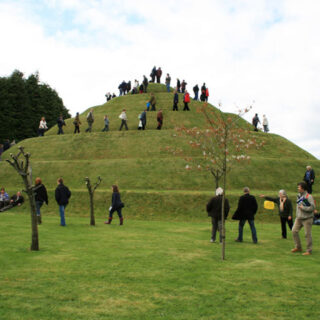
Comyn’s Castle is an interesting site, being a motte which deviates from the normal style. It consists of a D-shaped mound protected by double ditches.
The inner ditch is around 1.5m deep, while the outer ditch is around 2.0m to 3.0m deep. They protect the north and east side of the site, with the south and west site defended by naturally-sloping ground.
The unusual form of the motte suggests its origins may pre-date the 11th century date when a Norman castle is likely to have been established. The lands of Kilbride were originally owned by the Norman de Valognes family, Roger de Valognes receiving the barony of Kilbride around 1186. Around 1200 Alan fitz Walter gave the lands of Kilbride to Robert Croc, lord of Crookston, and his heirs in exchange for the 100 shilling land that Alan owed to Robert. This may have been a temporary arrangement however as upon the marriage of Isabel de Valognes to David Comyn in the early 13th century the estate came into the possession of the Comyn family. Following David’s death in 1247 the property passed to his son, William, and upon William’s death in 1283 to his eldest son, John. John died without an heir in 1290 and the castle passed to his brother, Edmund.
Sir Edmund Comyn of Kilbride fought at the Battle of Dunbar in 1296 alongside his cousins, John Comyn, 3rd Earl of Buchan, and John Comyn, Lord of Badenoch, but was captured and imprisoned by Edward I at Nottingham Castle until 1297. Upon his release he fought for Edward in Flanders but later returned to Scotland where he fought at the Battle of Roslin and then invaded England with Sir Simon Fraser of Oliver and Neidpath in 1303.
John Comyn, Lord of Badenoch, was a claimant to the vacant Scottish throne when his rival, Robert the Bruce, killed him in 1306. When Bruce ascended to the throne he set about confiscating the lands held by the Comyns and Edmund was stripped of his Scottish estates and titles. He would later die fighting on the English side at the Battle of Bannockburn in 1314.
Bruce gave the confiscated Comyn lands of Kilbride to his son-in-law, Walter Stewart. In 1382 the former Comyn estates were granted to the Lindsay family by King Robert II, in recognition of the help of the Lindsays in the murder of John Comyn.
Archaeological investigations suggest that the castle was destroyed in either the late 14th or early 15th century. This ties in with when the Lindsay family took over the estates, and may suggest that they started work on a new building at nearby Mains Castle around this time, robbing stone from Comyn’s Castle.
Only the mound and parts of the ditches are now visible, the north side of the outer ditch having been filled in.

Alternative names for Comyn's Castle
Kilbrid; Laigh Mains; Laigh Mains Motte; Motte of Kilbride